Cyprea Shells a wide variety from rare collector shells to the more common type
Cyprea shells or the more common name Cowry Shell are the most universally collected shells. They are prized for their colors, glossy surface and markings. There are approximately two hundred species. Most are found across the tropics.
In its first stage of growth the cowry develops a short pointed spire (a spire is the coiled part of the shell and it usually tapers to a point). As the shell grows the spire and its developing edge thickens. In its last stage of growth the edge thickens and it forms teeth along each side of the aperture (aperture is the opening at the front end of the shell).
The basic shape of the Cyprea shell varies little. However, they vary greatly in size, color, pattern and the arrangement of the teeth along the aperture.
Cyprea or Cowry shells are active at night and hide during day lite. They feed on algae near coral reefs.
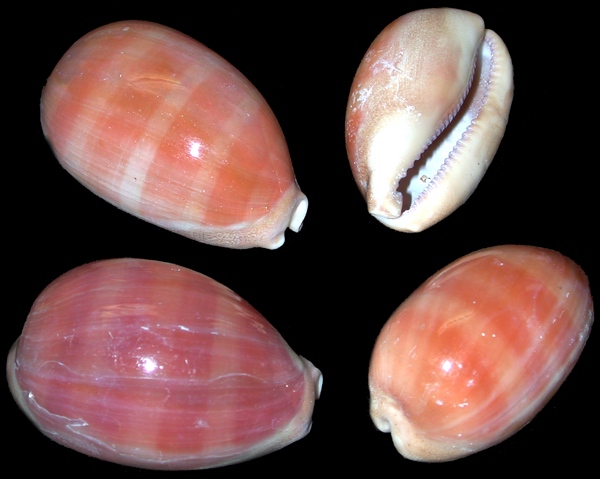
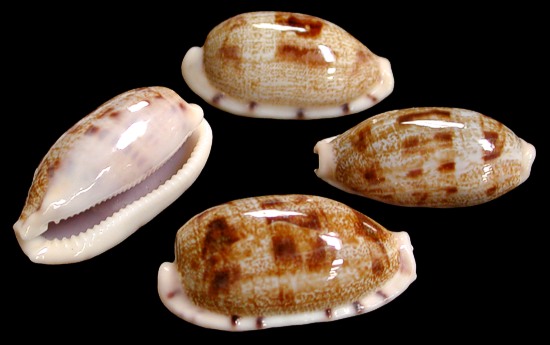
Lyncina carneola, common name the carnelian cowrie
This is a species of sea snail, a cowry, a marine gastropod mollusk in the family Cypraeidae, the cowries.
These cowries reach 1 to 3 inches in length. Their shape is rounded and the basic color is a pale orange-brown, with some transverse bands.
This species dwells in the seas off Aldabra, Chagos, the Comores, the East Coast of South Africa, Eritrea, Kenya, Madagascar, the Mascarene Basin, Mauritius, Mozambique, the Red Sea, Réunion, the Seychelles, Somalia and Tanzania.
Scientific classification
Kingdom: Animalia
Phylum: Mollusca
Class: Gastropoda
(unranked): clade Caenogastropoda
clade Hypsogastropoda
clade Littorinimorpha
Superfamily: Cypraeoidea
Family: Cypraeidae
Genus: Lyncina
Species: Lyncina carneola
Binomial name: Lyncina carneola
(Linnaeus, 1758)
Synonyms: Cypraea propinqua Garrett, 1879 Cypraea carneola Linnaeus, 1758 (basionym)(REF: Lyncina carneola( Linnaeus, 1758). WoRMS (2009). Lyncina carneola (Linnaeus, 1758). Accessed through the World Register of Marine Species)(REF: Fishelson, L., 1971. Ecology and distribution of the benthic fauna in the shallow waters of the Red Sea. Mar. Biol., Berl. 10 2)
CCC1-9
A Lyncina Carneola, also known as the Carnelian Cowrie measures from 1 to 2 inches, is a species of sea snail in the family Cypraeidae. This shell is usually pale orange-brown with some transverse bands, making it quite distinctive. ..... $6.75
1CCC1-9
Three Lyncina Carneolas, also known as the Carnelian Cowries measures from 1 to 2 inches, is a species of sea snail in the family Cypraeidae. This shell is usually pale orange-brown with some transverse bands, making it quite distinctive. ..... $7.80
11CCC1-9
Five Lyncina Carneolas, also known as the Carnelian Cowries measures from 1 to 2 inches, is a species of sea snail in the family Cypraeidae. This shell is usually pale orange-brown with some transverse bands, making it quite distinctive. ..... $8.95
111CCC1-9
Twelve Lyncina Carneolas, also known as the Carnelian Cowries measures from 1 to 2 inches, is a species of sea snail in the family Cypraeidae. This shell is usually pale orange-brown with some transverse bands, making it quite distinctive. ..... $11.45
1111CCC1-9
Twenty five Lyncina Carneolas, also known as the Carnelian Cowries measures from 1 to 2 inches, is a species of sea snail in the family Cypraeidae. This shell is usually pale orange-brown with some transverse bands, making it quite distinctive. ..... $21.95
CCC3-9
One Lyncina carneola (Cyprea Carneola) less than 1 inches ..... $6.75
1CCC3-9
Five Lyncina carneolas (Cyprea Carneola) less than 1 inches ..... $6.99
11CCC3-9
Twelve Lyncina carneolas (Cyprea Carneola) less than 1 inches ..... $7.95
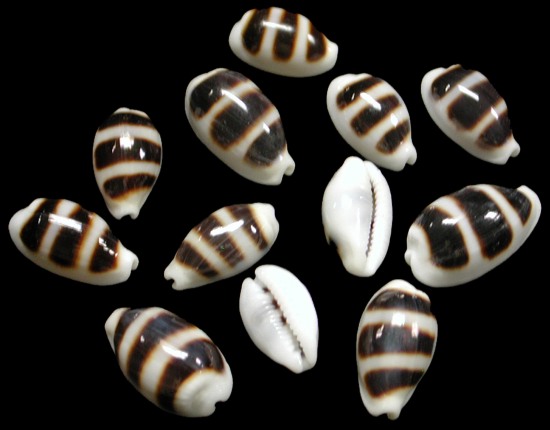
Palmadusta asellus
Palmadusta asellus is a species of sea snail, a cowry, a marine gastropod mollusk in the family Cypraeidae, the cowries.
Palmadusta asellus has a shell reaching a length of about 1 inch. The shells are white with three large brown transversal bands on the upper surface. The brown mantle shows several whitish spots. In the living cowry it covers almost entirely the shells.
These cowries are distributed in the seas along Aldabra, Chagos, the Comores, Kenya, Madagascar, Mauritius, Mozambique, the Red Sea, Réunion, the Seychelles and Tanzania.
Scientific classification
Domain: Eukaryota
Kingdom: Animalia
Phylum: Mollusca
Class: Gastropoda
Subclass: Caenogastropoda
Order: Littorinimorpha
Family: Cypraeidae
Genus: Palmadusta
Species: Palmadusta asellus
Binomial name: Palmadusta asellus
(Linnaeus, 1758)
Synonyms: Cypraea asellus
Linnaeus, 1758
(REF: Palmadusta asellus (Linnaeus). Retrieved through: World Register of Marine Species)(REF:Verdcourt, B. (1954). The cowries of the East African Coast (Kenya, Tanganyika, Zanzibar and Pemba). Journal of the East Africa Natural History Society)(REF: Burgess, C.M. (1970). The Living Cowries. AS Barnes and Co, Ltd. Cranbury, New Jersey )
V1-7
A Palmadusta Asellus, also known as the Little Donkey Cowry measuring 1/2 inch IThe shell is characterized by its white color with three large brown transversal bands on the upper surface....... $7.90
1V1-7
Five Palmadusta Asellus shells, also known as the Little Donkey Cowry measuring 1/2 inch These shells are characterized by their white color with three large brown transversal bands on the upper surface....... $13.95
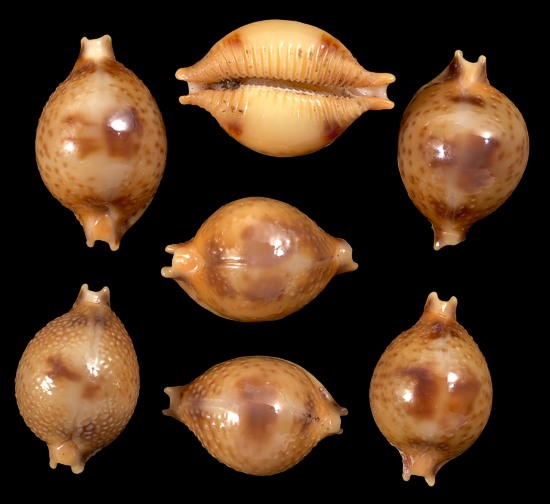
CYPREA SHELL BISTRINOTATA
The Cyprea Bistrinotat is a Cowry shell. It is noted for its color and unusual markings.
Like other Cowry species, the Cyprea Bistrinotata is active at night, prefers to live near coral reefs and is generally found across the Indo-Pacific region.
HH1-17
A Cyprea Bistrinotata measuring 1/2 inch. This cyprea shell, is noted for its distinctive color and markings. ...... $6.95
1HH1-17
Five Cyprea Bistrinotata shels measuring approximately 1/2 inch. These cyprea shells, are noted for their distinctive color and markings. ...... $9.95
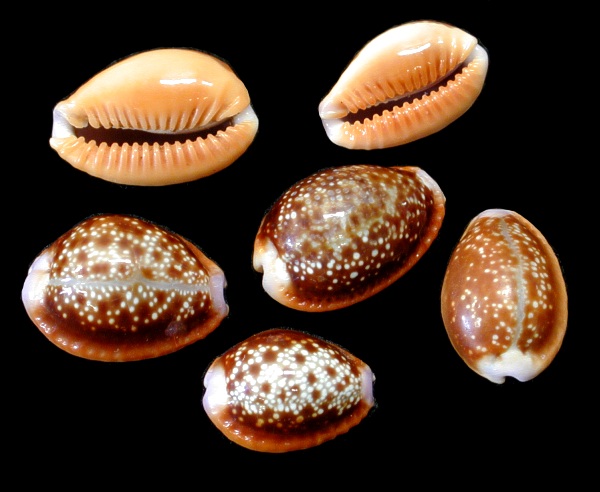
HELVOLA CYPREA
Description This a small solid elliptical shell with a covex base, often called the Honey Cowry. The teeth on each side well developed. There are darker brown colors between aperture teeth The color pattern is a lilac or pale blue. It has large brown spots intermixed with pale spots. The brilliant colors fade in time after capture.
Habitat They are found in tropical waters between the Indian Ocean eastward to the northern shores of Australia/New Zealand. Some have been found in the Southern Japanese waters. The Helvola Cyprea shell, like other Cowries are nocturnal, living near coral and rocky sea floors.
SCY1-260
A Cypraea Helvola measuring approximately 1/2 inch, The Helvola is commonly known as the Honey Cowry. They are small, solid, elliptical shell with a convex base. This shell is known for its beautiful color pattern, which includes large brown spots intermixed with pale spots, and a lilac or pale blue background....... $6.95
1SCY1-260
Five Cypraea Helvola measuring approximately 1/2 inch, The Helvola is commonly known as the Honey Cowry. They are small, solid, elliptical shell with a convex base. This shell is known for its beautiful color pattern, which includes large brown spots intermixed with pale spots, and a lilac or pale blue background....... $8.95
11SCY1-260
Twelve Cypraea Helvola shells measuring approximately 1/2 inch, The Helvola is commonly known as the Honey Cowry. They are small, solid, elliptical shell with a convex base. These shells are known for their beautiful color pattern, which includes large brown spots intermixed with pale spots, and a lilac or pale blue background....... $12.49
111SCY1-260
Twenty five Cypraea Helvola shells measuring approximately 1/2 inch, The Helvola is commonly known as the Honey Cowry. They are small, solid, elliptical shell with a convex base. These shells are known for their beautiful color pattern, which includes large brown spots intermixed with pale spots, and a lilac or pale blue background....... $17.95
(44)
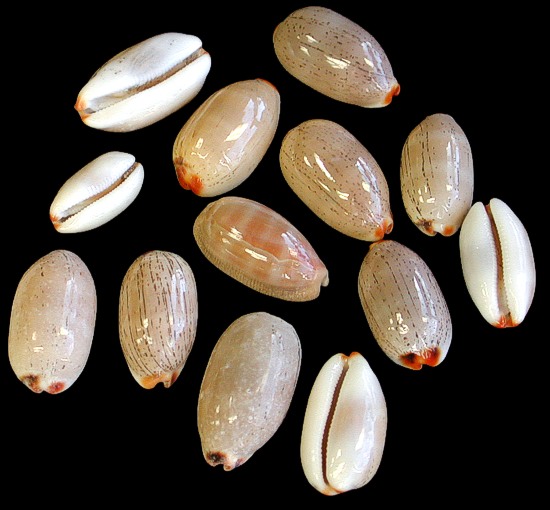
CYPREA ISABELA
This species can be found in the Red Sea, along the East African coast, the Mascarene Basin and in the Indo-West Pacific Ocean (Malaysia, Indonesia, Australia, Melanesia, Philippines, Southern Japan, Taiwan) up to Hawaii.
This species are found in a wide range of habitats, in shallow and in intertidal waters up to about 35 metres (115 ft) of depth. During the day they usually stay under rocks and stones or in small holes or coral caves. At dawn or dusk they start feeding on sponges, algae or coral polyps.
Scientific classification
Kingdom: Animalia
Phylum: Mollusca
Class: Gastropoda
clade Hypsogastropoda
clade Littorinimorpha
Super family: Cypraeoidea
Family: Cypraeidae
Genus: Luria
Species: L. isabella
SCY-300
A Cyprea Isabela shell measuring from 5/8 to 1 inch Isabela shells are known for their beautiful, glossy appearance and unique patterns. ...... $6.95
1SCY-300
Five Cyprea Isabela shells measuring from 5/8 to 1 inch Isabela shells are known for their beautiful, glossy appearance and unique patterns. ...... $7.95
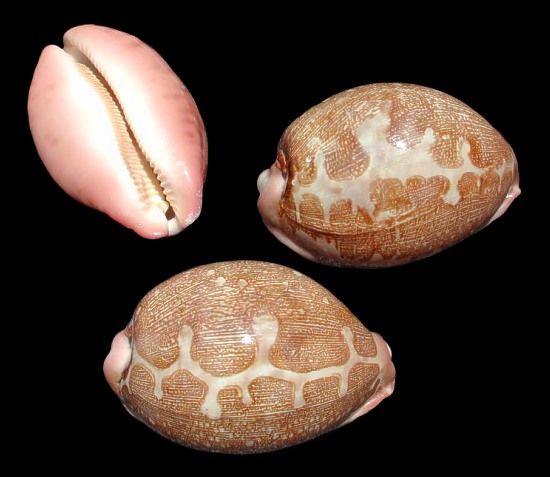
Cyprea Mappa pink base
Cyprea Mappa is found in the Indo-Pacific region from the Indian Ocean East to the North Australian/New Zealand shores.
Leporicypraea mappa (previously known as Cypraea mappa), common name the map cowry, is a species of large sea snail, a cowry, a marine gastropod mollusk in the family Cypraeidae, the cowries.
This species is collected in the Indo-West Pacific, where it is sold for food and shell trading.
The maximum shell length of this species is up to 4 inches, but it more commonly grows up to about 3 inches.
Leporicypraea mappa is widely distributed in the Indo-Pacific. It is present in many regions, including East Africa, Madagascar, southeastern Red Sea, eastern Polynesia, southern Japan, Australia and New Caledonia.
Scientific classification
Kingdom: Animalia
Phylum: Mollusca
Class: Gastropoda
clade Hypsogastropoda
clade Littorinimorpha
Superfamily: Cypraeoidea
Family: Cypraeidae
Subfamily: Cypraeinae
Genus: Leporicypraea
AA1-15
A Cypraea mappa shell measuring 2 1/2 to 3 inches, also known as the map cowrie, is a type of sea snail with a beautifully patterned shell. These shells are typically found in the Indo-West Pacific region and are popular among collectors for their unique appearance. ..... $7.49
1AA1-15
Five Cypraea mappa shell measuring 2 1/2 to 3 inches, also known as the map cowrie, is a type of sea snail with a beautifully patterned shell. These shells are typically found in the Indo-West Pacific region and are popular among collectors for their unique appearance. ..... $10.95
(84)
11AA1-15
Twelve Cypraea mappa shells measuring 2 1/2 to 3 inches, also known as the map cowrie. These are beautifully patterned shells. Cypraea mappa shells are typically found in the Indo-West Pacific region and are popular among collectors for their unique appearance. ..... $22.95
111AA1-15
Twenty five Cypraea mappa shells measuring 2 1/2 to 3 inches, also known as the map cowrie, these are beautifully patterned shells. Cypraea mappa shells are typically found in the Indo-West Pacific region and are popular among collectors for their unique appearance. ..... $34.95
(84)
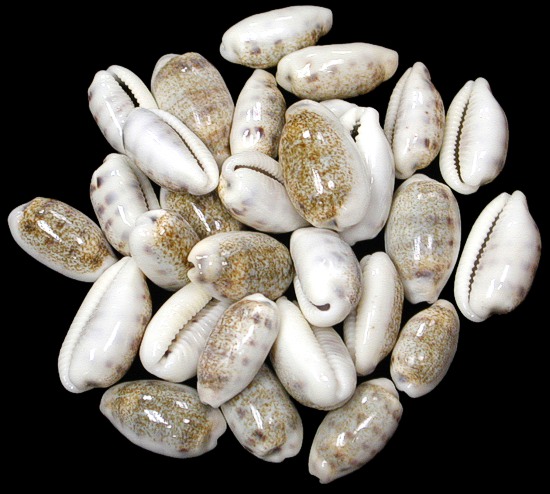
CYPREA PALLIDULLA SHELL
Blasicrura pallidula has a shell reaching a size of 1/2 inch to 1 1/4 inches. It is oval, the dorsum surface is usually pale brown, while the base is white. In the living cowries the mantle has a blackish coloration.
Range Indian Ocean to Northern Australian shores. Nocturnal (active at night) and feeds on algae. Prefers to hide in coral or rock crevices during the day.
Cyprea Palidulla are gastropods belonging to the Cowry family of shells.
Scientific classification
Kingdom: Animalia
Phylum: Mollusca
Class: Gastropoda
clade Hypsogastropoda
clade Littorinimorpha
Super family: Cypraeoidea
Family: Cypraeidae
Genus: Blasicrura
Species: B. pallidula
SCY-309
A Blasicrura Cyprea pallidula measuring 1/2 to 1 inch They are oval-shaped, with a pale brown dorsum surface and a white base. ......OUT OF STOCK
CYPREA TALPA SHELL
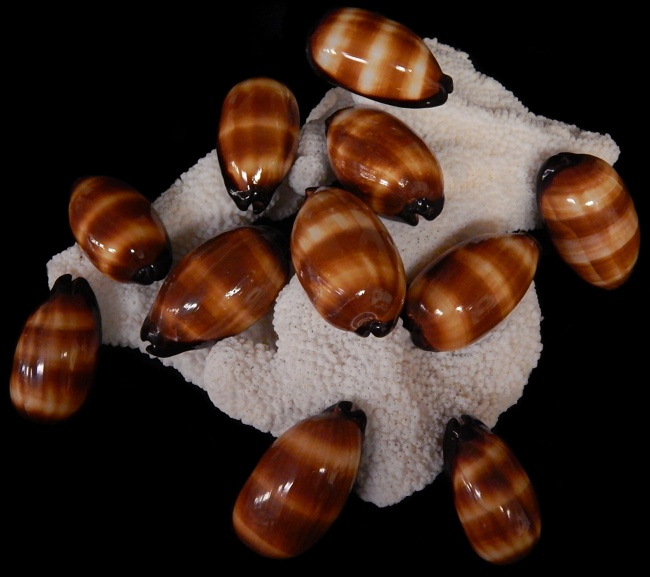
Talparia talpa, common name the mole cowry or chocolate banded cowry, is a species of sea snail, a cowry, a marine gastropod mollusk in the family Cypraeidae, the cowries.
This species have been found in the Red Sea, in the Indian Ocean along East Africa (Aldabra, Chagos, the Comores, Eritrea, Kenya, Madagascar, the Mascarene Basin, Mauritius, Mozambique, Réunion, the Seychelles, Somalia and Tanzania), in the western Pacific (western Australia, Philippines), in Polynesia and Hawaii.
These cowries live on coral reef or in shallow lagoons in tropical intertidal and subtidal waters up to 99 feet deep. They can be found under ledges and in small coral caves at night, as Talpa start feeding at dusk.
Scientific classification
Kingdom: Animalia
Phylum: Mollusca
Class: Gastropoda
clade Hypsogastropoda
clade Littorinimorpha
Super family: Cypraeoidea
Family: Cypraeidae
Subfamily: Luriinae
Genus: Talparia
Species: T. talpa
II1-17
A Cypraea Talpa shell measuring 2 to 3 inches They are also known as the Mole Cowrie,. These are beautiful shells found in the Indo-Pacific region near coral reefs. Talpas shells have a cream-colored base with darker horizontal stripes. ...... $6.95
1II1-17
Five Cypraea Talpa shells measuring 2 to 3 inches They are also known as the Mole Cowrie. Cypraea Talpa shells are beautiful shells found in the Indo-Pacific region near coral reefs. Talpa shells have a cream-colored base with darker horizontal stripes. ...... $11.95
11II1-17
Twelve Cypraea Talpa shells measuring 2 to 3 inches They are also known as the Mole Cowrie. Cypraea Talpa shells are beautiful shells found in the Indo-Pacific region near coral reefs. Talpa shells have a cream-colored base with darker horizontal stripes. ...... $25.95
111II1-17
Twenty five Cypraea Talpa shells measuring 2 to 3 inches They are also known as the Mole Cowrie. Cypraea Talpa shells are beautiful shells found in the Indo-Pacific region near coral reefs. Talpa shells have a cream-colored base with darker horizontal stripes. ...... $38.95
CYPREA TERES
Talostolida Teres, common name the tapering cowry, is a species of sea snail, a cowry, a marine gastropod mollusk in the family Cypraeidae, the cowries.
The shells of these common cowries grow to an average of 1 to 1 1/4 inches in length, minimum size of an adult Teres 1/3 of an inch and a maximum size of 1.7 inches.
They very in pattern and color.
The shape may be cylindrical or sub-cylindrical. The dorsum surface is smooth and shiny, the basic color is whitish, greenish or pale brown, with irregular dark brown patches, sometimes forming two-three transversal bands.
Their surface can be grey-greenish.
The margins are white or pale brown, with some dark dots and a pronounced labial callus.
The base is white or pinkish with fine short teeth.
The living cowries mantle is orange-reddish, with white sensorial papillae.
Mantle and foot are well developed, with external antennae.
This species and the subspecies are found in the Red Sea, in the Indian Ocean off East Africa and South Africa (Aldabra, Chagos, the Comores, Kenya, Madagascar, the Mascarene Basin, Mauritius, Mozambique, Réunion, the Seychelles, Somalia and Tanzania) and in Western and Eastern Pacific Ocean along Western Australia, Philippines and Hawaii.
The Teres cowries live on rocks or under corals in the intertidal zone.
Scientific classification
Kingdom: Animalia
Phylum: Mollusca
Class: Gastropoda
clade: Hypsogastropoda
clade Littorinimorpha
Super family: Cypraeoidea
Family: Cypraeidae
Genus: Talostolida
Species: T. teres
SCY-307
A Cypraea Teres shell measuring 1-inch, These shells are part of the cowry family, known for their smooth, glossy surfaces and beautiful patterns.......$6.95
1SCY-307
Five Cypraea Teres shells measuring approximately 1-inch, These shells are part of the cowry family, known for their smooth, glossy surfaces and beautiful patterns.......$9.95
11SCY-307
Twelve Cypraea Teres shells measuring approximately 1-inch, These shells are part of the cowry family, known for their smooth, glossy surfaces and beautiful patterns.......$15.95
111SCY-307
Twenty five Cypraea Teres shells measuring approximately 1-inch, These shells are part of the cowry family, known for their smooth, glossy surfaces and beautiful patterns.......$27.95
(70)
CYPRAEA ARGUS
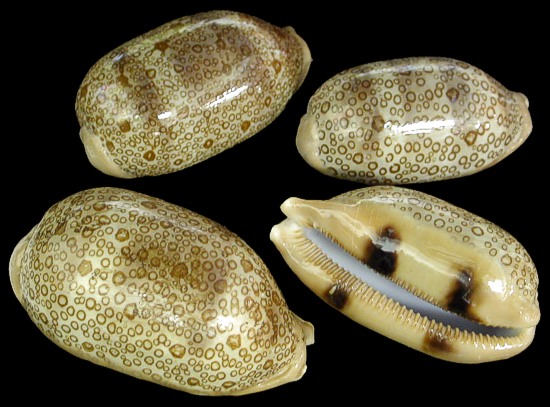
Arestorides argus, commonly called the eyed cowrie, is a species of sea snail, a cowry, a marine gastropod mollusk in the family Cypraeidae, the cowries.
The Argus cowry species average about 3 inches and can reach 4 1/2 inches. The shape of the shell is roughly cylindrical. The ground color is light to medium tan. Overlying the ground color of the dorsum are many rings of a medium brown color and varying sizes. The rings are likened to eye spots, thus the common name eyed cowry and the specific epithet argus (after Argus Panoptes, the many-eyed Greek giant). Some specimens have numerous small rings, others have fewer, larger rings; the number and size of rings varies between subspecies. The aperture is relatively straight, has well-developed teeth, and is flanked by two dark-brown blotches on each side (the blotches on the outer lip are sometimes small and indistinct).
The Argus and its subspecies are found in the Indian and Pacific Oceans. They have also been seen in the seas off Aldabra, Chagos, the Comores, Kenya, Madagascar, the Mascarene Basin, Mauritius, Mozambique, Réunion, the Seychelles, Somalia and Tanzania.
Scientific classification
Kingdom: Animalia
Phylum: Mollusca
Class: Gastropoda
(unranked): clade Caenogastropoda
clade Hypsogastropoda
clade Littorinimorpha
Super family: Cypraeoidea
Family: Cypraeidae
Genus: Arestorides
Species: A. argus
BB1-17
The Cypraea Argus shell measuring 3 inches Cyprea Argus shells are also known as the Eyed Cowrie which is a species of sea snail in the family Cypraeidae. They are known for their intricate "eye" design on a light brown background, with four dark brown bands at the base....... $4.25
CYPREA SAULAE
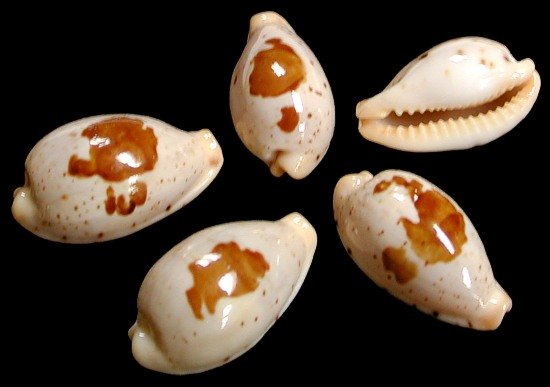
Palmadusta Saulae is a species of sea snail, a cowry, a marine gastropod mollusk in the family Cypraeidae, the cowries.
Scientific classification
Domain: Eukaryota
Kingdom: Animalia
Phylum: Mollusca
Class: Gastropoda
Subclass: Caenogastropoda
Order: Littorinimorpha
Family: Cypraeidae
Genus: Palmadusta
Species: P. saulae
This cowrie with a bright orange body ranges across the Indo-Pacific region is seldom seen.
The common size found is about 1 inch.
They are cylindrical, pale blue or greyish with 3 broad very pale brown bands and sparse tiny brown speckles all over.
These Cyprea sometimes, but not always have one or more brown blotches.
The Underside is white with dark brown spots.
The living animal has a bright orange mantle with sparse short white translucent hairs.
SMU-250
A Cypraea Saulae shell measuring 1-inch They are also known as the Saulae Cowry, is a species of sea snail in the family Cypraeidae. These shells are prized for their glossy surface and unique markings. ...... $7.00
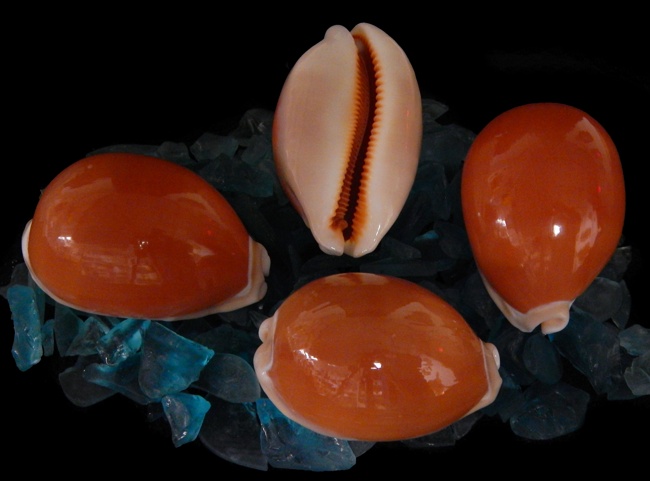
Cyprea Aurantium
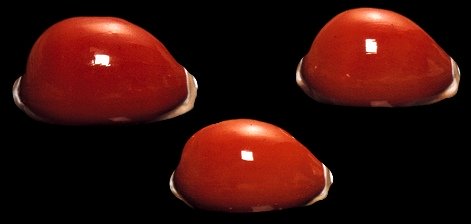
Callistocypraea aurantium, (formerly classified inside genus lyncina) common name the golden cowrie, is a species of sea snail, a cowry, a marine gastropod mollusk in the family Cypraeidae, the cowries.
These are uncommon-to-rare species which lives in the tropical waters of the west-central to south-central Pacific Ocean.
The Cyprea Aurantium are usually found on the ocean side of islands, on the reef, at depths of 30 to 100 feet.
It normally hides in the coral during daylight and comes out to feed at night.
Aurantiums are large cowries 3 to 4 inches long.
These shells are yellowish brown to reddish orange on the dorsum, with white to cream colored margins.
The mantle of the golden cowry is a combination of dark gray with translucent spots and patches, the orange color of the shell shows through.
The scattered branching papillae are brownish gray, often white at the bases and tips.
Historians point out that Fiji Islands chieftains once wore the shell (called bulikula) around their neck. Today they are a prized collector shell.
Scientific classification
Kingdom: Animalia
Phylum: Mollusca
Class: Gastropoda
(unranked): clade Caenogastropoda
clade Hypsogastropoda
A clade is a grouping that includes a common ancestor and all the descendants (living and extinct) of that ancestor
order Littorinimorpha
Superfamily: Cypraeoidea
Family: Cypraeidae
Genus: Callistocypraea
Species: C. aurantium
Binomial name Callistocypraea aurantium
**binomial nomenclature is a system of nomenclature in which each species of animal or plant receives a name of two terms of which the first identifies the genus to which it belongs and the second the species itself.
Our Cypraea Aurantiums have some stress lines but this is normal for the species.
D1-17
One Cypraea Aurantium shell 2 7/8 to 3 1/4 inches...... OUT OF STOCK
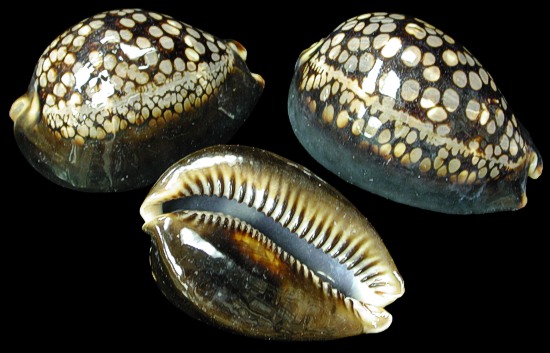
CYPRAEA MAURITIANA LINNAEUS
Mauritia Mauritiana, common names the humpback cowry, chocolate cowry, mourning cowry and Mauritius cowry, these are tropical sea snail, a cowry, a marine gastropod mollusc in the family Cypraeidae, the cowries.[
These are common cowries growing to an average of 2 to 3 inches in length, with a minimum size of 1.7 inches to a maximum size of about 5 inches.
The dorsum surface of these smooth and shiny cowries are generally dark brown, with distinct large yellowish or amber dots.
The edges of the dorsum and the base are completely dark brown.
The aperture is long and narrow, with several dark brown teeth and clear spacing.
In the living cowries the mantle is completely black, without sensorial papillae.
The Mauritiana Linnaeus are Indo-Pacific species, occurring in the Indian Ocean along South-East Africa and in the western Pacific Ocean (western and northern Australia, Malaysia, Philippines and Hawaii)
These cowries are mainly restricted to exposed habitats such as wave-washed basalt cliffs or breakwaters.
The Mauritia mauritiana lives in tropical low intertidal water, usually under rocks or in rocky crevices at a minimum depth of about 7 feet, but can be found in depths of 160 feet.
Scientific classification
Domain: Eukaryota
Kingdom: Animalia
Phylum: Mollusca
Class: Gastropoda
Subclass: Caenogastropoda
Order: Littorinimorpha
Family: Cypraeidae
Genus: Mauritia
Species: M. mauritiana
Binomial name: Mauritia Mauritiana
EE1&2-17
The Cypraea Mauritiana measuring 2 to 3 inches These are commonly known as the Mauritian cowrie, is a species of sea snail in the family Cypraeidae. These They are prized for their glossy surface and unique markings, making them a popular choice among collectors. ......$2.85
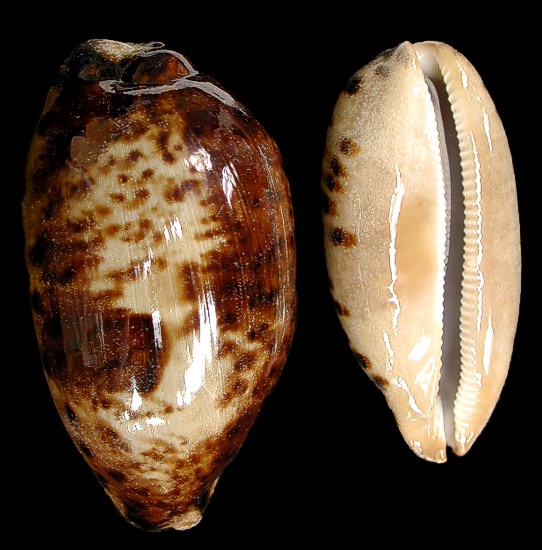
Chelycypraea testudinaria
Chelycypraea testudinaria, the common name is tortoise cowry, they are a species of sea snail, a cowry, a marine gastropod mollusk in the family Cypraeidae, the cowries.
These are not a rare species.
Testudinaria cowries grow to an average of 3 1/2 to 4 inches in length, with a minimum size of about 3 inches and a maximum size of 5 1/2 inches.
They have variable patterns and color.
The shape is oval or sub-cylindrical, the dorsum surface is smooth and shiny, the basic color is whitish or yellowish and it is covered by very irregular dark brown patches and spots.
The margins are white or pale brown, with some large dark dots.
The base may be whitish, pale brown or pink, the aperture is long and narrow and the teeth are white, short and fine.
The living animal has a mantle of bluish-greyish and almost transparent, while the sensorial papillae are lighter and long.
The mantle and foot are well developed, while The lateral flaps of the mantle can completely hide the dorsum surface.
These cowries can be found across the Indo-Pacific region along Aldabra, Chagos, the Comores, Kenya, Madagascar, the Mascarene Basin, Mauritius, Mozambique, Réunion, the Seychelles, Zanzibar and Tanzania, Malaysia, Samar Island, Sulu Sea, Vietnam and the Philippines.
These species live on coral reefs, in crevices and beneath large rocks in shallow subtidal waters to depths of 16 to 49 feet.
Scientific classification
Kingdom: Animalia
Phylum: Mollusca
Class: Gastropoda
(unranked): clade Caenogastropoda
clade Hypsogastropoda
clade Littorinimorpha
Super family: Cypraeoidea
Family: Cypraeidae
Subfamily: Luriinae
Genus: Chelycypraea
Species: C. testudinaria
Binomial name: Chelycypraea Testudinaria
SCY-310One Chelycypraea Testudinaria shell, measuring 4 to 5 inches......... $4.25
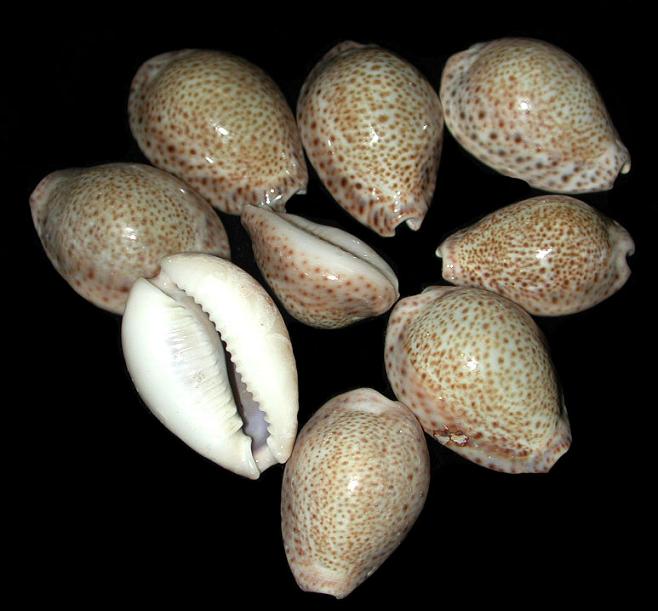
Cyprea Tarmus shell
Z2-8
One Cypraea Tarmus shell, measuring 2 inches or smaller...... .19
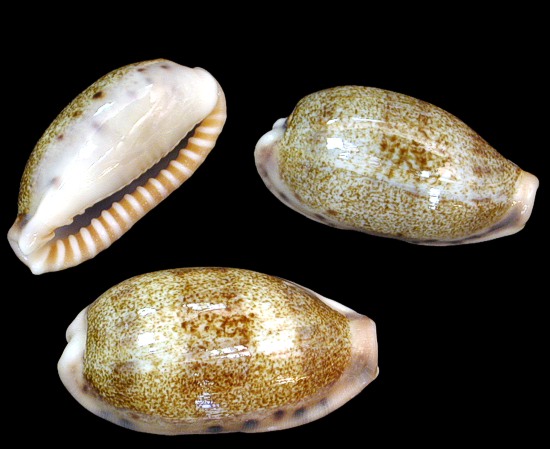
Erronea Caurica
Erronea caurica, common name the thick-edged cowry, is a species of sea snail, a cowry, a marine gastropod mollusk in the family Cypraeidae, the cowries.
These cowries can grow to 1 1/3 to 2 1/4 inches in length.
Their shape is elongated and the basic color is light brown or yellowish, with a pinkish underside and brown spots on the edge.
These species and subspecies are found in the Red Sea and in the Indian Ocean along Aldabra, Chagos, the Comores, East Africa, Kenya, Madagascar, the Mascarene Basin, Mauritius, Mozambique, Réunion, the Seychelles, Somalia and Tanzania.
The Caurica Cyprea Shell is a fairly common cowry, living near and around reefs. These Like other cowry shells prefers a nocturnal life (active at night).
Scientific classification
Domain: Eukaryota
Kingdom: Animalia
Phylum: Mollusca
Class: Gastropoda
Subclass: Caenogastropoda
Order: Littorinimorpha
Family: Cypraeidae
Genus: Erronea
Species: E. caurica
Binomial name: Erronea caurica
K0-7
One Erronea Caurica shell, measuring between 1 and 1.5 inches........ .49
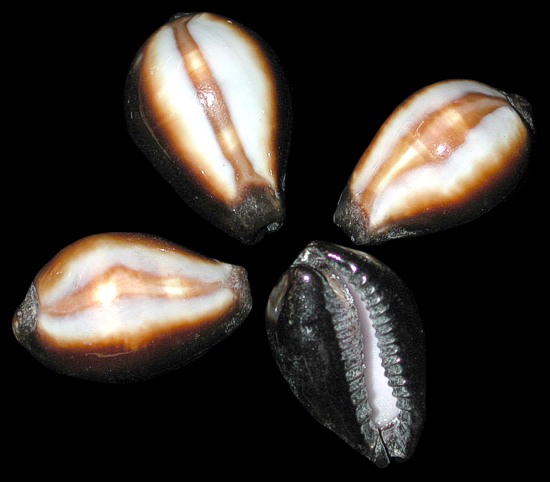
Erronea Onyx
Erronea onyx, common name the onyx cowry, are species of sea snail, a cowry, a marine gastropod mollusk in the family Cypraeidae, the cowries.
These are common cowries that grow to an average length of 1 1/3 to 1 1/2 inches in length, with a minimum size 7/8 inch and a maximum size 2 1/5 inches.
The dorsum surface of Erronea onyx is smooth, shiny and generally golden brown, with alternating longitudinal fuzzy bands of translucent bluish and reddish colors (the latin name onyx reflects this).
The base and the margins are dark brown or black, sometimes the teeth are orange.
The living cowries mantle is dark brown, thin, with bluish papillae.
This specie are found in the Indian Ocean on the coasts of Aldabra, the Comores, Kenya, Madagascar, Mauritius, Mozambique, Réunion, the Seychelles, Tanzania and in the Pacific Ocean along East China, Thailand, northern Australia, Indonesia, Philippines, Palau Islands and Solomon Islands.
Erronea onyx lives in tropical and subtropical zones, in shallow subtidal water up to depths of 16 to 82 feet, mainly in muddy areas or sandy sea floor, feeding on algae or coral polyps.
Scientific classification
Domain: Eukaryota
Kingdom: Animalia
Phylum: Mollusca
Class: Gastropoda
Subclass: Caenogastropoda
Order: Littorinimorpha
Family: Cypraeidae
Genus: Erronea
Species: E. onyx
Binomial name: Erronea Onyx
M0-7
One Erronea Onyx shell, 1 to 1 3/4 inches in size....... .59
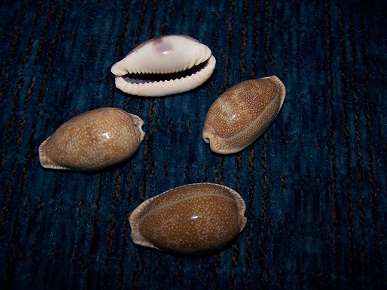
Cyprea Naria Erosa
Naria Erosa, common name the gnawed or eroded cowry, is a species of sea snail, a cowry, a marine gastropod mollusk in the family Cypraeidae, the cowries.
These are common cowries growing to an average of 1 1/3 to 1 1/2 inches in length, with a maximum size of 3 inches and a minimum adult size of 1/2 inch.
The dorsum is yellow-ocher or pale brown, with many small white spots.
The extremities of the shell show dark brown spots.
A dark brown area which is roughly rectangular is present on each side close to the edge.
The base is white to light beige, with thin transverse stripes.
These living cowries are active at night, during which the extremely papillose brownish mantle usually covers the shell completely, camouflaging the animal.
This species and its subspecies are found in the Indian Ocean along the coasts of Aldabra, Chagos, the Comores, the East Coast of South Africa, Kenya, Madagascar, the Mascarene Basin, Mauritius, Mozambique, Réunion, the Seychelles, Somalia and Tanzania, as well in the Western Pacific Ocean (Malaysia, Australia, Philippines, Polynesia and Hawaii).
These cowries live in warm tropical waters, on shallow intertidal reefs or in lagoons at depths of 6 1/2 feet to about 32 feet of depth.
Like most other cowries, during the day they usually hide under rocks slabs with the mantle drawn into the shell, they are nocturnal feeding only at dawn or dusk.
Scientific classification
Domain: Eukaryota
Kingdom: Animalia
Phylum: Mollusca
Class: Gastropoda
Subclass: Caenogastropoda
Order: Littorinimorpha
Family: Cypraeidae
Subfamily: Erosariinae
Genus: Naria
Species: N. erosa
Binomial name: Naria Erosa
E0-12
One Cyprea Naria Erosa shell measuring up to 2 inches....... .15

CSL1-17
A Cyprea Limacima shell measuring approximately 1/2 inch..... $1.69

Cypraea Millaris
CM1-17
A Cypraea Millaris shell measuring approximately 1/2 inch.... $1.69